How We Grew a Skincare Distributor’s Revenue 60% in 3 Months: Anna Lotan Kyiv Case Study
By Oksana Frolova | OMG Creative Marketing
Beauty brand marketing gets harder when your customer is not the end consumer but a professional. Anna Lotan Kyiv, the Kyiv distributor of the Israeli professional skincare brand Anna Lotan, sells to cosmetologists and salons. The brand was well known, the products were certified, and the company had a loyal base of more than 1,170 clients with an NPS of 9.56.
Still, loyalty among regular customers was slipping. There were no new products to talk about, training topics felt outdated, and social media was underdeveloped. Our task was to give cosmetologists a new reason to buy and to build a system that turns attention on social media into sales.
Step 1: Research before any ads
We started with the market. A competitor review and a SWOT analysis showed that almost every account in the niche followed the same pattern: product information, skin problems, and sales posts. Most competitors were official distributors, and few of them introduced individual specialists or ran online courses. Nobody in the segment used TikTok, and only a few were active on YouTube.
The analysis also highlighted strengths to build on: technologists and consultants who could train cosmetologists and answer any question, a call department working with the client base, and representatives in several Ukrainian cities. The main risks were lockdowns that could close salons and spas, stronger competitors with better offers, and “gray” distributors selling the same products cheaper.
Step 2: Understand who buys and why
The core buyer is a cosmetologist aged 35–45 with a medical education and at least eight years of experience. She constantly upgrades her skills and looks for new techniques.
She usually decides to buy when:
- a client arrives with a specific request and her current range is not enough;
- her stock is running out;
- she sees a good offer;
- the season changes: peels in autumn, SPF products in summer, hydration and nourishment in winter;
- colleagues or her cosmetology school recommend the products.
We also mapped her main objections: price increases, items out of stock, order errors, clients refusing home care, consultations that did not help, no regional manager, doubts that the products would handle a difficult case, delivery problems, and a lack of samples and printed materials.
Step 3: Call the client base before writing ads
Instead of guessing, we called existing customers. The conversations showed why cosmetologists choose Anna Lotan: home-care products, the brand’s cool hydration methodology, a brand they see as time-tested, high quality, natural formulas (99% natural ingredients), and a wide product line. Accessible training, discounts on multi-item orders, and products for peels and device treatments also mattered.
The most important insight was simple: cosmetologists buy professional products to earn money and to be confident in the result. They also want new techniques that will surprise their clients.
Step 4: Turn insights into one clear message
That insight changed the message. Instead of “buy our products,” the brand started talking about how to earn more from the clients a cosmetologist already has.
The buyer’s needs were clear: sell home care and raise the average check, keep a steady flow of paying clients who come back, receive good reviews, and grow her income. Her buying criteria were value for money, the economic benefit of each procedure, and natural ingredients.
The central idea for all offers: home care makes procedures more effective, and a cosmetologist who knows how to explain its value earns more. The ads promised to show how to explain home care to clients, how to sell it confidently, and how to improve results after peels. These were advertising angles, not guaranteed outcomes for every cosmetologist.
Step 5: Build offers for each campaign goal
We split the advertising by goal, with separate creatives for each:
- Follows: “Every cosmetologist should know how to sell home care. Follow us and learn how to explain its value to your clients.”
- Lead magnets: a guide to selling home care, a workbook on care before and after peels, and a UAH 300 credit toward a home peel product.
- Consultations: a free session with a brand technologist, with a gift: a webinar invitation and a discount on the home-care series.
- Webinar registrations: feed videos and Story carousels inviting cosmetologists to a free webinar on home care after peels.
The offers followed the season. In winter, the focus was on hydration and home peel care that keeps clients’ skin smooth and glowing.
We targeted four audience types: broad interests (anti-aging), narrow interests (cosmetology), the job title “cosmetologist,” and lookalike audiences built from the client base’s phone numbers and emails.
Step 6: An auto-webinar funnel instead of one-off posts
Instead of isolated promotions, we built an automated webinar funnel:
Creative → targeted ad → landing page for a free webinar → warm-up in the Instagram profile and Telegram channel → webinar with a gift → sale of the main products → repeat purchases (LTV)
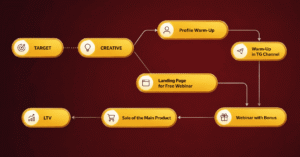
We tested several funnel variants: a landing page versus direct messages, different lead magnets, and several “sales windows” in posts before the webinar. The webinar was hosted by a cosmetologist-technologist with seven years of experience. She explained how to structure work with clients so they understand why home care matters and come back for results.
The Instagram content strategy was built around a community for professional cosmetologists and beauty salons, not just a product catalog.
What we did
This project combined several of our social media and advertising services:
- Pre-project research: target audience, competitors, and the company itself.
- Calls to the client base.
- An auto-webinar funnel: creatives, landing pages, Instagram warm-up, a Telegram warm-up sequence, the webinar structure, and a sales script for managers.
- An Instagram content strategy.
- A visual concept for Instagram.
- An Instagram message campaign for the client base.
- Content creation.
- Shoot supervision and visual production.
- Targeted advertising setup.
- Lead magnets.
Results
- Company revenue grew 60% in 3 months.
- The average check among existing clients grew 45%.
- Webinar conversion reached 10%.
- Brand awareness among the target audience increased.
These are reported results from one project in a specific market and period, not a forecast for another business. The growth also depended on the distributor’s own team: technologists, the call department, and sales managers who worked with the scripts.
What other B2B beauty brands can take from this
- Sell the professional’s result, not the product. A cosmetologist buys what helps her earn more and keep clients.
- Talk to customers before writing ads. The calls gave us the main message, and we could not have guessed it from competitors’ accounts.
- Give every ad one goal. Follows, leads, consultations, and webinar registrations need different offers.
- Connect marketing with sales. A funnel works when managers know what to say after the lead arrives.
Selling to cosmetologists, salons, or other professionals? Request a social media audit from OMG Creative Marketing. Share your product, your buyers, and your current sales path so we can discuss what to build first.